
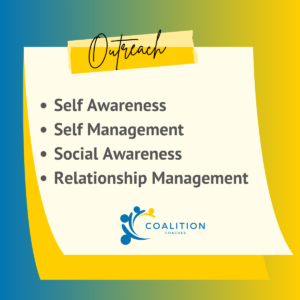
Coalition building = relationship building. When it comes to relationship-building, we have an ongoing challenge of developing new relationships and sustaining existing ones. While some of us may be more naturally inclined toward relationship-building, we are likely using skills that may not have been “named.” Jennifer participated in a video interview that was being incorporated into an online public health management course. One of the topics discussed was Emotional Intelligence. During the conversation, they asked Jennifer, “Do you think Emotional Intelligence is a managerial superpower?” Jennifer’s answer: “Yes!” As she reflected on the interview and discussion, she realized that Emotional Intelligence is also a superpower for a coalition leader. Join us this week as we highlight four aspects of Emotional Intelligence that will give you superpowers when it comes to relationship building and coalition building.
Self awareness.
The first place to begin reflecting and practicing emotional intelligence is by improving our own self awareness. This involves recognizing and naming our own emotions as well as their impact on other people. One of Jennifer’s favorite new books that can help us name and define emotions is Atlas of the Heart by Brené Brown. In order to develop self awareness, take time to reflect on your emotions in different situations. Although some of us may be more emotive than others, we all have emotions and may express those in different ways. Remember that the process of self awareness also involves learning about our strengths and weaknesses. While it may be easy to focus on our weaknesses and areas to improve, an important part of increasing self awareness is recognizing and spending time focused on our strengths. One of Jennifer’s favorite tools for understanding our strengths is the CliftonStrengths Assessment (formerly known as StrengthsFinder). Fun fact – you can hire Jennifer to assess your team’s strengths. She is now a certified trainer.
Self management.
When we practice self awareness, we have the opportunity to then practice self management. Self awareness helps us to name our emotions and understand who we are and how we interact with others. Self management helps us manage our emotions. This does not mean that we hold back showing our emotions and pretend that everything is ok when it is not. When we practice self management, we are choosing how we respond rather than letting ourselves react to every situation we face. Part of self management is also deciding when to respond and when to step away from the situation. Sometimes, we just need to step out of the room, go for a walk, run or some kind of physical activity (if possible) and then decide how we respond. Other times, we may stay in the situation, recognize the emotion (self awareness) and then respond demonstrating self control and respect to those around us. Self-compassion practices can also help with developing self management.
Social awareness.
Once we have spent time reflecting, naming and managing our emotions, we are in a better position to pay attention to others and their emotions. This is particularly important when leading coalition meetings. When you practice social awareness, you are able to facilitate the conversation and discussion more effectively. For instance, if you look around the room (or the zoom) and your participants look confused, concerned, bored, angry, excited or sad, you can make decisions about how to proceed with the conversation. Although you may think you know what is happening, it is a good idea to pause and check in with the group on what you perceive. For instance, if you have been meeting for a while and your participants look like they are getting restless or distracted, you may want to offer a bathroom or walk break and see how they respond. If you are correct, you will get a lot of support for this proposal and can then reconvene. In virtual meetings, you may want to ask some questions in the chat to assess the situation. Another aspect that is connected to social awareness is showing empathy. When you listen closely and pay attention to others, you are able to respond with empathy and understanding. One of Jennifer’s favorite short video examples of empathy vs. sympathy comes from Brené Brown.
Relationship management.
Once we have become aware of our emotions and the emotions of others and are practicing managing our own emotions, we can then practice relationship management. This aspect of emotional intelligence focuses on interacting positively with others and is related to helping others work better together. When we are demonstrating high levels of relationship management, we recognize the value in others and help bring out the best in them. We are able to identify potential “win-win” opportunities and are able to make connections, encourage engagement, communicate clearly, coordinate well and collaborate effectively. When we demonstrate the emotional intelligence skill of relationship management, we create opportunities for our coalition to do more together than we ever could on our own.
If you would like to read further on Emotional Intelligence and Leadership as well as these four domains, one of Jennifer’s favorite books is: Primal Leadership: Realizing the Power of Emotional Intelligence.
_______
Join us the 3rd Thursday of the month for our live Coalition Spotlight Conversation: https://info.coalitioncoaches.com/coalition-spotlight